
Sunday, September 14, 2008
SRD OLED
Hmm, must investigate further. But people seem to continue developing quite interesting architectural products that can revolutionize "sustainable" design.


I'm back from life for life.
ok, not that anyone reads, but here is a new post. First in two months. I have been living, a lot, and have forgotten what I was doing with said life. I needed the experiences I've had, but I need this also. Just to ease into things, I'll put up a link and leave it at that for now.
Sunday, July 6, 2008
Maracatú Atômico
Olha lá vai passando a procissão/Se arrastando que nem cobra pelo chão/As pessoas que nela vão passando acreditam nas coisas lá do céu/As mulheres cantando tiram versos, os homens escutando tiram o chapéu/Eles vivem penando aqui na Terra/Esperando o que Jesus prometeu/E Jesus prometeu coisa melhor/Prá quem vive nesse mundo sem amor/Só depois de entregar o corpo ao chão, só depois de morrer nestesertão/Eu também tô do lado de Jesus, só que acho que ele se esqueceu/De dizer que na Terra a gente tem/De arranjar um jeitinho prá viver/Muita gente se arvora a ser Deus e promete tanta coisa pro sertão/Que vai dar um vestido prá Maria, e promete um roçado pro João/Entra ano, sai ano, e nada vem, meu sertão continua ao Deus dará/Mas se existe Jesus no firmamento, cá na Terra isso tem que seacabar
A Procissão, Gilberto Gil
Last week, I saw Gilberto Gil live at the Nokia Theater with my mom. She showed me his music way back in the day, (as his, it's not like his music doesn't play everywhere in Brasil) and I would not let his show go by without her seeing him.
Let me just say before anything else: Gilberto Gil can play! Shit, can he play! And sing! And dance! And he's 66 years old! He was dancing around like a maniac, screaming from the top of his lungs, giving evil looks to the crowd, and even doing a bit of ginga (capoeira move). All this out of someone whose black/gray/white dreadlocks probably weighed as much as the rest of his body.
His band was incredible as well, seamlessly switching between completely different musical styles, combining them, switching rythms, arrangements, and the like. And it wasn't just some musical masturbatory exercise (as per my most recent Prefuse 73 show, which made me quite upset); this was a concert designed to make you dance. My mom and I did not stop the whole time, we kept bumping into some not-so-happy concertgoers, but we didn't care. We came here to enjoy some incredible music by moving to it, not just staring mindlessly at the guitarists fingers. For that, you move to the side...
Now, this leaves my list of brasileiros i have to see on stage one name shorter:
Caetano Veloso
Gilberto Gil
Chico Buarque
Milton Nascimento
Jorge Ben(jor)
DJ Dolores
Edu Lobo
Olodum
Nação Zumbi
Zuco 103
Marcelinho da Lua
A Procissão, Gilberto Gil
Last week, I saw Gilberto Gil live at the Nokia Theater with my mom. She showed me his music way back in the day, (as his, it's not like his music doesn't play everywhere in Brasil) and I would not let his show go by without her seeing him.
Let me just say before anything else: Gilberto Gil can play! Shit, can he play! And sing! And dance! And he's 66 years old! He was dancing around like a maniac, screaming from the top of his lungs, giving evil looks to the crowd, and even doing a bit of ginga (capoeira move). All this out of someone whose black/gray/white dreadlocks probably weighed as much as the rest of his body.
His band was incredible as well, seamlessly switching between completely different musical styles, combining them, switching rythms, arrangements, and the like. And it wasn't just some musical masturbatory exercise (as per my most recent Prefuse 73 show, which made me quite upset); this was a concert designed to make you dance. My mom and I did not stop the whole time, we kept bumping into some not-so-happy concertgoers, but we didn't care. We came here to enjoy some incredible music by moving to it, not just staring mindlessly at the guitarists fingers. For that, you move to the side...
Now, this leaves my list of brasileiros i have to see on stage one name shorter:
Chico Buarque
Jorge Ben(jor)
DJ Dolores
Edu Lobo
Olodum
Nação Zumbi
Zuco 103
Marcelinho da Lua
Friday, July 4, 2008
not-so-weekly update 2:
hmmm.
So much for that idea...
Here's the count:
Last blog entry: 2008.06.15_12.09 (finished 2008.07.04)
Blog entries, last 19 days: 1
Time to get it right...
So much for that idea...
Here's the count:
Last blog entry: 2008.06.15_12.09 (finished 2008.07.04)
Blog entries, last 19 days: 1
Time to get it right...
Sunday, June 15, 2008
cradle-to-cradle
Read the book Cradle to Cradle, by Michael Braungart and William McDonough. This chemist/architect pairing began in the late 80's and early 90's when these two were amongst many people trying to figure out ecologically sound solutions for product design and mass produced goods. The two began brainstorming about ways to create/build product so that they could be disassembled into biodegradable and recyclable components. The main objective behind this would be to close the product loop, so that nothing is thrown out at the end (there is no end). This is in contrast to recycling, which while valuable, still produces waste, doesn't stop its product from being thrown out post-use, and creates pollution of its own. The current system, therefore, is called cradle to grave.
This book touches on the most important changes to be made within manufacturing industries, building industries, and the general public/society, as outlined by Braungart and McDonough's philosophy:
1. There are two alternative for the life cycles of products, depending on if they are biodegradable or not. biodegradable products are made purely of biodegradable materials, and can be thrown out by the consumer upon consumption without worry or specific location. These products must be composed of safe materials and chemicals, both during and post-use. Other products may contain some less safe materials and chemicals, though offgassing of these chemicals must be minimal. Also, such chemicals as dioxins and carcinogens (but I thought everything was a carcinogen...) are strictly prohibited from use in any product. These synthetic products can be upcycled, meaning they can be reused in a constant cycle, in the same composition or a higher-level use than previously. Currently, recycled materials tend to be of lower quality than their predecessors. Biodegradable and non biodegradable components may be combined in the same product, but only through easily and safely detachable physical bonds.
2. Production facilities must be safe for workers and the surrounding community, and should be active participants/contributors to the community. New production systems can be implemented that do not use toxic chemicals. Factories and other buildings can utilize environmentally friendly building materials and technologies, and can use "sustainable" infrastructure such as solar/wind/micro-hydroelectric energy, composting waste, water capture/reuse/treatment.
3.Ecology, Equity, and Economy can and should work hand in hand, but they should be equal in priority within a manufacturer's operations. To balance these 3 ideals is to create a truly successful business model that is not unsustainable. Businesses can approach this balance from any angle, but the end result should be equality of purpose.
Anyway, I thoroughly enjoyed reading this book, printed on paper and plastic impermeable pages, and am now more willing to think beyond the general guidelines of what is sustainable, into the realm of what is effective, regenerative, and therefore more attractive/feasible.
My one complaint with the cradle-to-cradle system is the lack of effort in engaging the public, and even companies themselves. Perhaps because it is just one business engaging with other businesses, the public scope is too large. In the place of cradle-to-cradle's detailed and specific studies, a third-party rating system similar to LEED has emerged, called SMaRT (run by MTS, or Market Transformation for Sustainability). While it may not seem so from the unfriendly website, these ratings are easier to understand than cradle-to-cradle, but rely on a lot of paperwork, and less research by the third-party. The research and product development comes from the company itself; all MTS and other parties do is study the information they are given and assessing points based on a system. More standardized, but not necessarily as helpful on a case-by-case basis.
Either way, it seems a revolution in product design and manufacturing is happening. Hopefully the general public wakes up to this and begins to overhaul their living in the same way.
This book touches on the most important changes to be made within manufacturing industries, building industries, and the general public/society, as outlined by Braungart and McDonough's philosophy:
1. There are two alternative for the life cycles of products, depending on if they are biodegradable or not. biodegradable products are made purely of biodegradable materials, and can be thrown out by the consumer upon consumption without worry or specific location. These products must be composed of safe materials and chemicals, both during and post-use. Other products may contain some less safe materials and chemicals, though offgassing of these chemicals must be minimal. Also, such chemicals as dioxins and carcinogens (but I thought everything was a carcinogen...) are strictly prohibited from use in any product. These synthetic products can be upcycled, meaning they can be reused in a constant cycle, in the same composition or a higher-level use than previously. Currently, recycled materials tend to be of lower quality than their predecessors. Biodegradable and non biodegradable components may be combined in the same product, but only through easily and safely detachable physical bonds.
2. Production facilities must be safe for workers and the surrounding community, and should be active participants/contributors to the community. New production systems can be implemented that do not use toxic chemicals. Factories and other buildings can utilize environmentally friendly building materials and technologies, and can use "sustainable" infrastructure such as solar/wind/micro-hydroelectric energy, composting waste, water capture/reuse/treatment.
3.Ecology, Equity, and Economy can and should work hand in hand, but they should be equal in priority within a manufacturer's operations. To balance these 3 ideals is to create a truly successful business model that is not unsustainable. Businesses can approach this balance from any angle, but the end result should be equality of purpose.
Anyway, I thoroughly enjoyed reading this book, printed on paper and plastic impermeable pages, and am now more willing to think beyond the general guidelines of what is sustainable, into the realm of what is effective, regenerative, and therefore more attractive/feasible.
My one complaint with the cradle-to-cradle system is the lack of effort in engaging the public, and even companies themselves. Perhaps because it is just one business engaging with other businesses, the public scope is too large. In the place of cradle-to-cradle's detailed and specific studies, a third-party rating system similar to LEED has emerged, called SMaRT (run by MTS, or Market Transformation for Sustainability). While it may not seem so from the unfriendly website, these ratings are easier to understand than cradle-to-cradle, but rely on a lot of paperwork, and less research by the third-party. The research and product development comes from the company itself; all MTS and other parties do is study the information they are given and assessing points based on a system. More standardized, but not necessarily as helpful on a case-by-case basis.
Either way, it seems a revolution in product design and manufacturing is happening. Hopefully the general public wakes up to this and begins to overhaul their living in the same way.
weekly updates?
Seems as if I only make time to write on here once a week. So I'll try to give weekly updates of how my updating of the site is going. And maybe try to go on here more often.
Last blog entry: 2008.06.08_22.06
Blog entries, last 7 days: 2
Last blog entry: 2008.06.08_22.06
Blog entries, last 7 days: 2
Sunday, June 8, 2008
look out below... ...and above too!
Update from latest crane incident:
The lead inspector of cranes and derricks at the NYC Department of Building was accused yesterday, under suspicion of taking bribes from a crane company, and selling crane operation licensing exam responses from the same company.
Hm. That's very surprising. I never would have thought the inner workings of any public entity in a huge and bureaucracy-rich city such as New York would be subject to such lobbying/bribery. My oh my.
Well, I guess it's time to react to it when people start dying in public.
The lead inspector of cranes and derricks at the NYC Department of Building was accused yesterday, under suspicion of taking bribes from a crane company, and selling crane operation licensing exam responses from the same company.
Hm. That's very surprising. I never would have thought the inner workings of any public entity in a huge and bureaucracy-rich city such as New York would be subject to such lobbying/bribery. My oh my.
Well, I guess it's time to react to it when people start dying in public.
more films, latin american style
Here are a couple more synopses on films I've seen recently, which both happen to be from Latin America:
 Manda Bala, by Jason Kohn (2007)
Compelling, I think is the best description for this documentary. It attempts to make sense of the chaos that is brasilian society, based on its may incarnations and reactions to crime. The two main forms of crime that are juxtaposed are money laundering by politicians, and kidnapping of these and other rich by the poor. Along for the ride are frog farmers, reconstructive plastic surgeons, bombastic anti-kidnapping division policemen, and paranoid "mauricinhos" (stuck up rich boys, in brasilian slang). Metaphors are thrown around, and even though they may be direct they are not overemphasized, instead taking shape through the scenes, cuts, and cinematography. Which, by the way, is quite stunning at times, even though none of these filmmakers had ever directed or produced anything (so kudos to the camerawoman, you rock!).
I think the most surprising emotion I came away with from this movie is not so much anger at conditions i already knew existed (the poor being abused by the rich, especially in the north of the country; the extremely poor trying to take something for themselves through any means, and leaving their morals in the backburner; or the rich ignoring the actual conditions of the poor and resorting to stereotypical portrayals of the poors as ignorants for justification), but more at a current thread through all of these characters: the brasilian ability to adapt, to innovate in order to succeed, the jeitinho that apparently permeates through most brasileiros. I wonder if I see too much into this theme in anything brasilian i experience, but it seems to make sense too often. Maybe it's a good thing I'm an architect. Time to put the jeitinho to work...
 El Crimen Del Padre Amaro, by Carlos Carrera (2002)
1. Based on a seemingly anti-catholic novel written before 1800 about scandals involving priests, and loves forbidden by already outdated canonical laws.
2. Hot, good actors and actresses. ok, actor and actress... ...and she's really not that good, but Gael Garcia Bernal is. Though I think they went a bit too telenovela with the love story aspect. But maybe I'm just not wired for these things.
3. Peasants turning against heretics while priests fund hospitals through laundered drug lord money. That just about brings the story up to the late 20th and early 21st century.
4. leprosy, catholic witch doctors, abortion, blackmailing, and coronaries. And a lot of talk about Mexican food.
So the film wasn't necessarily great, but it had its highlights. Though I still can't figure out the general point of view of the writers/producers/directors, especially regarding religion and organized religion. B ut I will say, one of my favorite moments was the recitation of dirty Holy Book passages during sex. HOT! And definitely better overall as a movie than most American romances nowadays.
 Manda Bala, by Jason Kohn (2007)
Compelling, I think is the best description for this documentary. It attempts to make sense of the chaos that is brasilian society, based on its may incarnations and reactions to crime. The two main forms of crime that are juxtaposed are money laundering by politicians, and kidnapping of these and other rich by the poor. Along for the ride are frog farmers, reconstructive plastic surgeons, bombastic anti-kidnapping division policemen, and paranoid "mauricinhos" (stuck up rich boys, in brasilian slang). Metaphors are thrown around, and even though they may be direct they are not overemphasized, instead taking shape through the scenes, cuts, and cinematography. Which, by the way, is quite stunning at times, even though none of these filmmakers had ever directed or produced anything (so kudos to the camerawoman, you rock!).
I think the most surprising emotion I came away with from this movie is not so much anger at conditions i already knew existed (the poor being abused by the rich, especially in the north of the country; the extremely poor trying to take something for themselves through any means, and leaving their morals in the backburner; or the rich ignoring the actual conditions of the poor and resorting to stereotypical portrayals of the poors as ignorants for justification), but more at a current thread through all of these characters: the brasilian ability to adapt, to innovate in order to succeed, the jeitinho that apparently permeates through most brasileiros. I wonder if I see too much into this theme in anything brasilian i experience, but it seems to make sense too often. Maybe it's a good thing I'm an architect. Time to put the jeitinho to work...
 El Crimen Del Padre Amaro, by Carlos Carrera (2002)
1. Based on a seemingly anti-catholic novel written before 1800 about scandals involving priests, and loves forbidden by already outdated canonical laws.
2. Hot, good actors and actresses. ok, actor and actress... ...and she's really not that good, but Gael Garcia Bernal is. Though I think they went a bit too telenovela with the love story aspect. But maybe I'm just not wired for these things.
3. Peasants turning against heretics while priests fund hospitals through laundered drug lord money. That just about brings the story up to the late 20th and early 21st century.
4. leprosy, catholic witch doctors, abortion, blackmailing, and coronaries. And a lot of talk about Mexican food.
So the film wasn't necessarily great, but it had its highlights. Though I still can't figure out the general point of view of the writers/producers/directors, especially regarding religion and organized religion. B ut I will say, one of my favorite moments was the recitation of dirty Holy Book passages during sex. HOT! And definitely better overall as a movie than most American romances nowadays.
Sunday, June 1, 2008
look out below...
Monday, May 26, 2008
South African xenophobia
And I thought Americans and Europeans were anti-immigration...
Seems people everywhere have a general distrust of immigrants. Frankly, If I were in a situation where I could not find a job but other people people got them mostly because of their willingness to work for less, I would be pissed too. However, I certainly wouldn't blame the people trying to find a job themselves, or even necessarily the employers trying to create an efficient business (though grossly underpaying whoever will take any amount of money and be afraid of doing anything that may cost him his job is not the soundest of policies, from a humanitarian or business standpoint). The government of that country needs to enploy some of these people in stadium construction efforts for the World Cup, and maybe to begin to train them for some service jobs that will emerge during the sporting event. That is a small gesture, I guess, but in my opinion may actually give some validity to the notion that a major sporting event actually does help the hosting community. Of course, there needs to be a plan of job replacement, period, if not a plan to empower people with their own business opportunities. Maybe a small loans program, or just more education opportunities. In fact, even some free meal programs for children, or better health care, can lead to great improvement in the general economic condition over time. If children are better educated and fed, they may be more helpful in the home/field, and will most definitely live through their childhood. This will most likely result in lower birth rates, less expenses for the parents, and a better household. Everything else follows.
But job creation is important as an immediate measure. However, I don't know much about the economy of South Africa, which is why I blurted out World Cup at the first chance.
I just hope people begin to understand that their misfortune is not necessarily the fault of someone else's fortune. Though resources of wealth and happiness may sometimes seem inadequate for all, that is not necessarily true. If those involved in these situations want to, they can share these resources to everyone's benefit. That, however is the problem.
Seems people everywhere have a general distrust of immigrants. Frankly, If I were in a situation where I could not find a job but other people people got them mostly because of their willingness to work for less, I would be pissed too. However, I certainly wouldn't blame the people trying to find a job themselves, or even necessarily the employers trying to create an efficient business (though grossly underpaying whoever will take any amount of money and be afraid of doing anything that may cost him his job is not the soundest of policies, from a humanitarian or business standpoint). The government of that country needs to enploy some of these people in stadium construction efforts for the World Cup, and maybe to begin to train them for some service jobs that will emerge during the sporting event. That is a small gesture, I guess, but in my opinion may actually give some validity to the notion that a major sporting event actually does help the hosting community. Of course, there needs to be a plan of job replacement, period, if not a plan to empower people with their own business opportunities. Maybe a small loans program, or just more education opportunities. In fact, even some free meal programs for children, or better health care, can lead to great improvement in the general economic condition over time. If children are better educated and fed, they may be more helpful in the home/field, and will most definitely live through their childhood. This will most likely result in lower birth rates, less expenses for the parents, and a better household. Everything else follows.
But job creation is important as an immediate measure. However, I don't know much about the economy of South Africa, which is why I blurted out World Cup at the first chance.
I just hope people begin to understand that their misfortune is not necessarily the fault of someone else's fortune. Though resources of wealth and happiness may sometimes seem inadequate for all, that is not necessarily true. If those involved in these situations want to, they can share these resources to everyone's benefit. That, however is the problem.
piece keepers
It seems some U.N. peacekeepers have been abusing children all over the world. Another strike against the United Nations, who should be seen by all people of the world as protectors. So much for that. I know these are isolated cases, but for an organization that consistently sets its economic and political goals to oblige by the will of the Most Developed Countries, an appearance of failure at any other level, especially concerning trust, is seriously damaging. Count some of these other incidents along with this, and how can this organization be trusted, especially on the ground, where it is actually more likely to make a difference?
well, I don't know what else to say right now...
well, I don't know what else to say right now...
Favorite albums, rough draft
A list, not exhaustive, not refined, and not in order...
Clube da Esquina - Milton Nascimento, Lô Borges
Os Afro Sambas - Baden Powell, Vinícius de Moraes, Quarteto em Cy
Estrangeiro - Caetano Veloso
Noites do Norte - Caetano Veloso
Acabou Chorare - Os Novos Baianos
Abbey Road - Beatles
Downtown Science - Blockhead
Classics - Ratatat
Ratatat - Ratatat
Deadringer - RJD2
Since we Last Spoke - RJD2
Like Water for Chocolate - Common
The Listening - Little Brother
Tributo - Suba
Buena Vista Social Club - Ibrahim Ferrer
Blackstar - Mos Def & Talib Kweli
Bambas e Biritas - Bid
Median's Relief - Median
Murray's Revenge - Murs
Midnight Marauders - A Tribe Called Quest
Panis et Circencis - Tropicália artists
Simple Things - Zero 7
Mezzanine - Massive Attack
Homework - Daft Punk
Discovery - Daft Punk
Sem Lenço, Sem Documento - Caetano Veloso
Minha História - Gilberto Gil
The Miseducation of Lauryn Hill - Lauryn Hill
Pause - Four Tet
Rounds - Four Tet
Vocal Studies/Uprock Narratives - Prefuse 73
One Word Extinguisher - Prefuse 73
DJ Kicks - DJ Cam
Power in Numbers - Jurassic 5
EndTroducing - DJ Shadow
Aparelhagem - DJ Dolores
10 Seconds - Jel
Soft Money - Jel
Greenball - Jel
Brazilian Girls - Brazilian Girls
Confusão Urbana, Suburbana e Rural - Paulo Moura
Da Lama ao Caos - Chico Science e Nação Zumbi
Gold - Edu Lobo
Epistemology - Diplo
In a Space Outta Sound - Nightmares on Wax
A Procura da Batida Perfeita - Marcelo D2
Lost Subject - Deceptikon
Madvillainy - Madvillain
The Mirror Conspiracy - Thievery Corporation
Red Hot & Riot - Various Artists
Remedies - The Herbaliser
Very Mercenary - The Herbaliser
Tales of High Fever - Zuco 103
The Shining - J-Dilla
Saul Williams - Saul Williams
Music by Cavelight, vol. 1 - Blockhead
Stankonia - Outkast
The Thesis - MC Coffee Mug
Kakuesi - DJ Krush
Mylight - DJ Krush
Cold Krush Cuts - DJ Krush & Coldcut
Talkie Walkie - Air
Come With Us - Chemical Brothers
Figure 8 - Elliot Smith
Travelling Without Moving - Jamiroquai
3rd Eye Vision - Hieroglyphics
Hotter Than July - Stevie Wonder
Bebel Gilberto Remixed - Bebel Gilberto
The Three EP's - Beta Band
A Arte de Tom Jobim - Tom Jobim
Vespertine - Björk
Blazing Arrow - Blackalicious
Livro - Caetano Veloso
Cansei de Ser Sexy - Cansei de Ser Sexy
Stereotype A - Cibo Matto
Contraditório - DJ Dolores & Orchestra Santa Massa
The Underground Spiritual Game - Fela Kuti
Paparazzi Lightning - Ghostland Observatory
Narradores de Javé Remix - Instituto vs. DJ Dolores
FabricLive 09 - Jacques Lu Cont
Hail to the Thief - Radiohead
Louden Up Now - !!!
Clube da Esquina - Milton Nascimento, Lô Borges
Os Afro Sambas - Baden Powell, Vinícius de Moraes, Quarteto em Cy
Estrangeiro - Caetano Veloso
Noites do Norte - Caetano Veloso
Acabou Chorare - Os Novos Baianos
Abbey Road - Beatles
Downtown Science - Blockhead
Classics - Ratatat
Ratatat - Ratatat
Deadringer - RJD2
Since we Last Spoke - RJD2
Like Water for Chocolate - Common
The Listening - Little Brother
Tributo - Suba
Buena Vista Social Club - Ibrahim Ferrer
Blackstar - Mos Def & Talib Kweli
Bambas e Biritas - Bid
Median's Relief - Median
Murray's Revenge - Murs
Midnight Marauders - A Tribe Called Quest
Panis et Circencis - Tropicália artists
Simple Things - Zero 7
Mezzanine - Massive Attack
Homework - Daft Punk
Discovery - Daft Punk
Sem Lenço, Sem Documento - Caetano Veloso
Minha História - Gilberto Gil
The Miseducation of Lauryn Hill - Lauryn Hill
Pause - Four Tet
Rounds - Four Tet
Vocal Studies/Uprock Narratives - Prefuse 73
One Word Extinguisher - Prefuse 73
DJ Kicks - DJ Cam
Power in Numbers - Jurassic 5
EndTroducing - DJ Shadow
Aparelhagem - DJ Dolores
10 Seconds - Jel
Soft Money - Jel
Greenball - Jel
Brazilian Girls - Brazilian Girls
Confusão Urbana, Suburbana e Rural - Paulo Moura
Da Lama ao Caos - Chico Science e Nação Zumbi
Gold - Edu Lobo
Epistemology - Diplo
In a Space Outta Sound - Nightmares on Wax
A Procura da Batida Perfeita - Marcelo D2
Lost Subject - Deceptikon
Madvillainy - Madvillain
The Mirror Conspiracy - Thievery Corporation
Red Hot & Riot - Various Artists
Remedies - The Herbaliser
Very Mercenary - The Herbaliser
Tales of High Fever - Zuco 103
The Shining - J-Dilla
Saul Williams - Saul Williams
Music by Cavelight, vol. 1 - Blockhead
Stankonia - Outkast
The Thesis - MC Coffee Mug
Kakuesi - DJ Krush
Mylight - DJ Krush
Cold Krush Cuts - DJ Krush & Coldcut
Talkie Walkie - Air
Come With Us - Chemical Brothers
Figure 8 - Elliot Smith
Travelling Without Moving - Jamiroquai
3rd Eye Vision - Hieroglyphics
Hotter Than July - Stevie Wonder
Bebel Gilberto Remixed - Bebel Gilberto
The Three EP's - Beta Band
A Arte de Tom Jobim - Tom Jobim
Vespertine - Björk
Blazing Arrow - Blackalicious
Livro - Caetano Veloso
Cansei de Ser Sexy - Cansei de Ser Sexy
Stereotype A - Cibo Matto
Contraditório - DJ Dolores & Orchestra Santa Massa
The Underground Spiritual Game - Fela Kuti
Paparazzi Lightning - Ghostland Observatory
Narradores de Javé Remix - Instituto vs. DJ Dolores
FabricLive 09 - Jacques Lu Cont
Hail to the Thief - Radiohead
Louden Up Now - !!!
Saturday, May 17, 2008
recently (relatively) viewed films
 Slam, dir. by Mark Levin
Typical tale of a hard luck African American stuck in a life of petty crimes and gang mentality, which he eventually overcomes through his lyrical talent and some luck. Except in this case the protagonist, played by slam poet/rapper Saul Williams, gets himself out of trouble while in prison via his craft, not having to turn to physical violence at any point in time, and eventually straddling between different demographics of African American society. This is a poor, short description of the film, but it's not the plot or the cinematography that make this film. It's Sal Williams. This man is an engaging personality no matter what medium he participates in. First I ever heard of him (besides hearing his name) was when I saw him open for Aesop Rock at South by Southwest music festival in Austin, TX a few years back. His performance made me an immediate fan; he was by far the best that night. In this film, his poems are incredible, from the way in which they are delivered, to the lyrics themselves, to how they become catalysts for the story. The plot always takes a turn when a poem is recited, and Williams' acting catapults off of the enthusiasm of the poems. Worth seeing.
 Harold and Maude, dir. by Hal Ashby
This film has been on my to-see list for a while, seeing that it's one of my best friend's favorite movie. The characters portrayed in this film are excellent. Harold's morbid pranks around his mother, and general infatuation with death, give the film a great early comedic slant. Maude's general disregard for societal conventions at the same time connect and disconnect the audience from reality, a real-life version of Harold's absurd stagings. Harold's mother's obsession with marrying Harold off and assimilating him into high society give the film its closest semblance to a prototypical antagonist, but it is really society that is the antagonist in this movie; Harold and Maude represent the personal freedoms that had become so publicly battled for in the previous decade (60's)... ...albeit extended into the realm of absurdity. I really enjoyed this film, and the soundtrack by Cat Steven kicks ass.
 El Crimen Perfecto (The Perfect Crime) dir. by Alex de la Iglesia
Alex de la Iglesia is definitely an Almódovar protegé. There is no way around it; controlling and borderlne insane female characters, chauvinistic male leads, and twisted plots usually including violent crimes, murders, and exposing the protagonists to their most ingenuous instincts. This specific film details the story of Rafael, a salesman at the women's section of a department store, who is obsessed with his profession, and the beautiful women that come along with it. After some disappointing work-related news, he accidentally commits a crime, only to have someone at work help him cover up his tracks... ..ok, this is very difficult to describe without giving the story away (as is the next film on this list). Trust me, this is an incredible film about desperation, skewed values, and obsession. Watch it!
 La Comunidad (Common Wealth) dir. by Alex de la Iglesia
Another tale of crime and trickery, but this one involves an entire building full of tenants, a disenchanted real estate agent, and a whole lot of money! Unexpected twists start from the early stages of the movie, and the cast of characters, and how little they evolve through the film, is astounding. I think one of the main points that de la Iglesia gets across (and I in no way know if this is his intent) is that people don't necessarily change much as a result of extreme circumnstances. More likey, they adapt to the conditions at hand to get themselves out of trouble, and that adaptation oftentimes is mistaken as learning, or evolution. This may be just an extreme criticism of most movies that involve lessons, in which characters learn life lessons just because of love for one character (cheesy American romantic comedies come to mind) or financial troubles that render them equal to those he once looked down upon (a lot of classic dramas). De la Iglesia's characters are more realistic than that, and it makes them much more interesting and engaging to the viewer. Oh, and by the way, Carmen Maura is in this flick. She is a demi-goddess of cinema.
 Bande à Part (Band of Outsiders), dir. by Jean-Luc Godard
You know, I was much more of a fan of Truffaut than Godard, but I'm starting to think it was more a result of me not being so moved (more likely confused) by Alphaville, and being so enamored with 400 Coups. The more I watch Godard, the more I begin to understand his genius. This storyline is not that different than most other crime stories, but the cinematography, characters, abrupt scenes juggled into the plot, and general high level of innovation and playfulness made this one of my favorite films in a long time. No script, innovative camera work, use of no extraneous lighting, disregard for cinematic conventions, and fast-flowing, irreverent action make this a must-see, a true masterpiece. And Anna Karina is exquisite.
 The Weather Underground, dir. by Bill Siegel and Sam Green
An insightful documentary, if only because of present times' intersecting history with the 60's. This film portrays the story of The Weather Underground, a radical leftist group that emerged from the student liberal movements of the early 1960's. This particular group eschewed peaceful means of protest, choosing instead to literally fight the establishment. This violent attitude led the group to move underground in the late 60's and 70's, from where they were still effective in bombing politically relevant establishments and pursuing equality and peace through their own means. This film includes interviews with some of the leaders of the movement, as well as some of the experts that tried in vain to capture them. This film rose a lot of issues for me when I watched it. One is how the leftist movement evolved during that decade, and how conditions then differed from now, especially having to do with disadvantaged people, and level of comfort in life for those protesting. Today's youth (catchphrase, yes, but I'm definitely including myself in this) is too comfortable, it has nothing personal to fight for. Even back then, many people were in some kind of peril: African Americans were fighting for their civil rights, young Americans were fighting for peace and against the possibility of being thrust into war, families were fighting to bring their loved ones home. And economically, none of those groups were nearly as well provided as we are now in first-world countries. Make no mistake about it, those people had good intentions, but they were fighting for issues that affected them personally, and had very little to lose. Could we possibly be too comfortable to fight for justice and peace? Do we just not care, and did we ever? What happens now, when those that have very few means to fight for their rights and opportunities (in poor countries or restrictive situations) need to do so on their own? And what means of protest can even be effective in this day and age, when it seems that marches and civil disobedience do not affect people with the same strength, even when practiced?
 Tropa de Elite (Elite Squad), dir. by José Padilha
Yes, yet another Brazilian film about organized crime, drug trafficking and the favelas. So why did this win many awards, and is showing up at film festivals around the world? Well, people like repetition, and realistic stories in which they can rally behind the disadvantaged of the world from behind a screen (kind of the way I do on this blog), but this story is different. First off, it is a story from the point of view of the police, specifically the BOP, or "elite squad" that intervenes in the favelas when the military police loses control of situations (which is often). Secondly, because of its specific point of view, it tries to debunk a different set of myths about crime in Brasil; it attacks the notion (sometimes too aggressively) that all police in Brasil are corrupt. At the same time, it shows throughout the story that most police are in fact corrupt. But, it pinpoints a few honest man that actually care about the law (what that means in Brasil, I don't know), and that try to fight through the mediocrity and corruption of the police force. It's insightful, but at times blood-curdling and excessively violent. Excessively violent, that is, if this level of violence wasn't actually present in Rio.
Monday, May 5, 2008
the end of poverty, pt.1
Just finished reading The End of Poverty by Jeffrey Sachs. First off, it was at the same time an inspiring and an infuriating read; in fact, I'm sure it was meant to be so. The foreign aid and world poverty situation is absolutely unnecessary, and relatively easy to solve; this makes the topic itself infuriating. But very few people are aware of the facts, and even differing opinions on the issues, and the ones that do have too many other concerns, bureaucratic obstacles, and idealistic differences to create true change. I'm not going to sit here and repeat everything he says either, and I have my skepticism as to the volition of Americans and other rich countries to give their money to the poorest of the poor, as well as to their citizen's goodwill at the expense of their own wealth (this includes me, but now I feel like I need to do something... ...wow, sad that I need a kick in the butt too). But I do agree that this is a solvable issue. Sachs says the whole can be solved with foreign aid given to state governments, who must submit a plan of action to the UN, and be supervised by its agencies on the field. The argument is that monetary aid to individuals, or private program aid, does not solve the problems of the countries in any sustainable manner; these are merely stopgap or localized measures. Commendable, to be sure, but they don't solve all of the problems.
Saturday, May 3, 2008
Foodies
 So it seems the food crisis keeps getting worse, and all people can talk about is stopping biofuels. How about we give these people some food, and raise our own? No, that would be too much of a sacrifice. Maybe if we tell some state governments (Haiti, for example) to spread their wealth, while giving them some monetary aid to do so? No, that would be hypocritical and would take funds away from the iraq war. Take away subsidies from American farmers, to even out the playing field and create an actual free market? No, that would be unpatriotic. Send over farming technologies that these people can easily learn how to use but cannot afford? Nah, we would probably need the "wonderful efficiency" of biofuels to transport that and people forced us to stop making them...riiight.
Well, I think it's timeour governments make some actual sacrifices. Or else we'll be the only ones left standing. Maybe that's less of a burden on our shoulders. Since we've done all we can, there's no reason to feel guilty, right?
Monday, April 21, 2008
Earth Day!
 Earth Day is upon us, and while I usually gloss over holidays, occasions, and anniversaries, I feel this one is specifically noteworthy, especially considering the need for a global shift in environmental policy. I'm not incredibly radical in this issue, not going so far as saying we all have to completely change the way we eat, produce, supply, or live. At least not yet, maybe. I think. We do have to begin making changes that are easier and simple, while making some bigger strides in our personal/community lives. But organizing on local, regional, and global scales has become a necessity.
Political action is crucial to resolving, or even making strides towards resolving, our ecological issues; here our old friend explains why.
More than changing the exposure politicians give to environmental issues, or invoking the participation of the US in international environmental agreements, the politicization of this "agenda" will lead to better public transportation, transit laws, alternative energy funding, zoning/code changes to allow more green roofs and urban gardens. These and other political moves will set up an infrastructure of progress and sustainability, from which people will comfortably change the way they live. But then the question becomes: if people are not willing to change the way they live within the status quo, why would they fight to create a situation for change? There's less personal investment necessary in the latter, I would argue, and it is almost universally accepted that a crisis is at hand. Some people have no sense of urgency about the situation, some people are just plain selfish, while others just don't know what to do about it. What needs to happen is that those of us with some more information about the situation need to take positions of leadership on all scales (local, regional, global), and share this information. Figure out how to give someone a personal stake, an immediate interest in the situation. We need to find out how to best petition our political representatives to make sure they include the environment on their agenda. We must insert global warming and other environmental issues into the presidential and other political campaign dialog. We must to mobilize the global citizenry to alter the course of the world. Every day shall be Earth Day if we follow with this declaration.
My commitment is renewed today.
The NJ4
Ran across this little public service announcement, about homophobic brutality in NYC, and the consequences to those who fight back. Here's a blog entry on this incident.
While I think people should never resort to aggression, and I do separate aggression from self defense, and I do believe (from the descriptions of the incident) that at least one of the women was aggressive, I don't think they would have harmed the man in question unless they were seriously threatened. They were trying to intimidate the man, to make him leave them alone. Not to mention that it seems they did not apparently commit any serious crime, and that three men who entered the fry were responsible for the "victim"'s wound. Anyway, they are heading to jail for 3 1/2 to 11 years, for trying (albeit aggressively) to defend themselves. Some justice...
While I think people should never resort to aggression, and I do separate aggression from self defense, and I do believe (from the descriptions of the incident) that at least one of the women was aggressive, I don't think they would have harmed the man in question unless they were seriously threatened. They were trying to intimidate the man, to make him leave them alone. Not to mention that it seems they did not apparently commit any serious crime, and that three men who entered the fry were responsible for the "victim"'s wound. Anyway, they are heading to jail for 3 1/2 to 11 years, for trying (albeit aggressively) to defend themselves. Some justice...
Sunday, April 20, 2008
WTC plans
A homeless man found a couple of sets of drawings on the Freedom Tower at the World Trade Center, and of course The Post made a fuss about it. Then, in true architect fashion, the bloggers and posters at archinect decided to make light of the whole thing...
The lessons: beware of homeless terrorists, old drawings and all the wasted paper at my firm do have post-consumer use, believe everything you read, and never trust architects.
The lessons: beware of homeless terrorists, old drawings and all the wasted paper at my firm do have post-consumer use, believe everything you read, and never trust architects.
Green Publication
New York Times magazine is publishing its green issue today. I haven't seen the paper copy; I wonder if it's made from recycled paper, or if they just refused to print it and gave people a link to the website instead...
Just began reading some of the articles, and I'm actually quite impressed. I didn't expect the writers to have much knowledge on the topic, and while they don't necessarily convey any information i didn't know before, the articles seem to give a full spectrum of the situation, not just relying on carbon offsets and biofuels. Maybe this will actually inform some readers.
Maybe then issues like this will be moot:
“People react really negatively to phrases like ‘density,’ but they react really positively to phrases like ‘walkability.’ ”
Just began reading some of the articles, and I'm actually quite impressed. I didn't expect the writers to have much knowledge on the topic, and while they don't necessarily convey any information i didn't know before, the articles seem to give a full spectrum of the situation, not just relying on carbon offsets and biofuels. Maybe this will actually inform some readers.
Maybe then issues like this will be moot:
“People react really negatively to phrases like ‘density,’ but they react really positively to phrases like ‘walkability.’ ”
Matt Lerner, developer, walkscore.com
Monday, April 14, 2008
Chinese characters
 yeah, right...
The other major issue in Chinese policy coming to the forefront due to the Olympics is the imprisonment of the state of Tibet within the Chinese Republic. The torch relay has become a constant platform for protests, with the current trek through India (with its thousands of Tibetan expatriots) as possibly the most combustible stop yet. It's even sparked an alternative torch relay for human rights. But while these recent events may have woken up the IOC (somewhat) and prompted China's bullshit positive spin measures, it does not seem to have fazed the people of the host country. Apparently, Chinese citizens are taught from early on (through history classes and other propaganda) about the lack of patriotism and generally defiant behavior of the devious Dalai Lama and his cronies... ...in fact, a friend of mine living in China (who sent me that article) describes her experiences in trying to discuss the issue with the young Chinese this way:
...afraid i'm not in close contact with lots of chinese friends. my closest chinese friend might as well be american. talked to another chinese friend about all it. she just kept saying she's so angry and she doesn't understand why people are protesting. she feels T is a part of china. i asked her why and she just said that from a young age that's what they learn. most chinese people don't ask why, they just accept things and sometimes arguments aren't arguments at all. then she wanted to know what i think. i said that i just think it's unfair that their own leader is exiled. and that americans value freedom and that's why most of us feel T should be on its own. i tried explaining that they have their own language and culture, but she just said that many parts of china have their own language and culture - which is true, but their languages are dialects. this friend is one of my favorite chines friends, but that doesn't matter. think about all the history textbooks and propaganda every country has. and then talk to them about what their gov't does wrong. ***note: i've left out referencing any country in particular; i'm pretty sure all these emails get scanned for specific words. with the limited information that is in the media, one wouldn't be able to understand the whole situation with important pieces of information missing. to question what you think your gov't does requires you to step out of being a part of that country and looking in. that's near impossible for a country with a majority of citizens who are extremely nationalistic. so i'm sort of moving towards imposing my opinion, but yeah...that's been my experience so far. i don't really get a chance to talk to chinese people about it - mostly because my friends are not chinese, but also because i'd have to comfortable enough to talk to a chinese friend about it in the first place.
I guess I have to add that she's not going to be able to read this bog there, because the federal government of China censors access to websites of a certain nature, blogs being one of them. Iran, for all the villifying done of its society by the Bush administration, has almost complete internet freedom, with few exceptions. This accentuates just how necessary the Chinese federal government (rightfully) sees its control of the ignorance of its populace.
Even the most educated of the Chinese, even those that live in other countries where they are exposed to different opinions, if raised in mainland China can keep some of these views. A co-worker of mine is quite intelligent, articulate, and generally a person compatible with me morally (besides religion). But when any negative press about China is reported (poisoned toys, pollution, rapid suburban expansion), she strives to remove any culpability from her native people and government. Maybe it's the latent feeling of patriotism that i have as well, but more likely it's imbedded idealism. My patriotism doesn't prevent me from criticizing the corruption and injustices of my country, it's governments, it's police, etc. In fact, my patriotism hinges on being able to criticize my country's actions, and react in a way that I think will improve it, and consequently the world. China, and its people, need to do the same, and quickly/actively. The fate of the world may just rest on them.
Saturday, April 12, 2008


Friday, April 11, 2008
meathead
Just read an editorial on the issue of food shortage around the world, specifically related to meat (in response to this piece of news). The author makes some interesting points about the amount of food being eaten by farm animals that become our steaks, including the fact that the grain could be used for biofuels. That statement in and of itself assumes that biofuels are something we should be striving for. I feel that at this point, we should be investing our efforts in solar, wind, wave, and other renewable energies, not on alternative fuels. The transformation of these plants into usage-ready fuel does create its own pollution; biofuels are not a panacea.
Another point of contention is that the food used to feed these animals could help feed the hungry in all over the world, and that people from rich countries, specifically America, throw away much of their food. While those contentions are technically true, they fail to consider for the transportation and preservation costs of moving this food across continents and oceans. Work should be done on improving the living conditions of people in their own country, not on giving people handouts that will not improve their long-term situation in the least. Second, the wastefulness of Americans and other rich peoples is an issue of its own, it seems to me irrelevant to the discussion of the harnessing of food for cattle.
So I don't necessarily disagree with the main issue at hand: we eat too much meat. But I do think it is part of most people's diet, and if eaten in moderation could remain so. I also think the author of the editorial really does not investigate the issue much or at least fails to educate the reader on the context of the issue at hand. This simplistic look at crucial issues of our times really angers me, especially if one is writing about it in public. I really expected a real argument full of intricacies, but all I got was a rant, like this one.
Activists need to be informers, not just propaganda-screaming cogs. Or else they are merely putting themselves at the same level as their "rivals".
But I could be wrong; maybe it's all the methane and fat in my brain, from my beef and pork-rich diet...
Another point of contention is that the food used to feed these animals could help feed the hungry in all over the world, and that people from rich countries, specifically America, throw away much of their food. While those contentions are technically true, they fail to consider for the transportation and preservation costs of moving this food across continents and oceans. Work should be done on improving the living conditions of people in their own country, not on giving people handouts that will not improve their long-term situation in the least. Second, the wastefulness of Americans and other rich peoples is an issue of its own, it seems to me irrelevant to the discussion of the harnessing of food for cattle.
So I don't necessarily disagree with the main issue at hand: we eat too much meat. But I do think it is part of most people's diet, and if eaten in moderation could remain so. I also think the author of the editorial really does not investigate the issue much or at least fails to educate the reader on the context of the issue at hand. This simplistic look at crucial issues of our times really angers me, especially if one is writing about it in public. I really expected a real argument full of intricacies, but all I got was a rant, like this one.
Activists need to be informers, not just propaganda-screaming cogs. Or else they are merely putting themselves at the same level as their "rivals".
But I could be wrong; maybe it's all the methane and fat in my brain, from my beef and pork-rich diet...
Sunday, April 6, 2008
activist youtube?
Here are some youtube clips I've come across this morning. They are made by activist groups, some are a bit satirical, and quite accessible to the public. I don't necessarily agree with everything on these videos, and the second one is a bit sophomoric (i hate that word, but it's there to be used... I was a very smart sophomore, damn it), but they are fun nevertheless.
-green consumption by the International Forum on Globalization.
-civilization
-renewable energy by Greenpeace UK
-orangutan by Greenpeace UK
well, I guess the last one isn't satirical, and a bit one-dimensional in its thinking... but might as well put it on there.
-green consumption by the International Forum on Globalization.
-civilization
-renewable energy by Greenpeace UK
-orangutan by Greenpeace UK
well, I guess the last one isn't satirical, and a bit one-dimensional in its thinking... but might as well put it on there.
Wednesday, March 26, 2008
Carnaval Brasileiro, 4: Desfile (parade)
 Here is my sketchbook ("field book", as my aunt liked to call it) entry for the Carnaval parade, translated from Portuguese to English:
WOW!!!!!!!
Now, this is a party!
From the moment I got to my aunt's mom's apartment, I couldn't sit still, and kept wondering when we would leave to go line up with the school. Beija-Flor was going last, since it won the parade the year before, so we really were not going to leave the apartment for the walk over to the Sambódromo until at least 2. I wanted to leave at 11, get to the concentration zone early to see everyone arriving... ...I wanted to see it all! I also wanted to try a certain cravo escarlate (scarlet clove) drink i had been told about. Apparently it's some mysterious potion that you drink before parading that "lifts your spirits" and gives you the energy to go through with the thing. hmmmm...
To distract us a little, someone told my cousin about a good luck custom (simpatia) to keep it from raining. We were supposed throw soap on a neighbor's roof, one big piece and one small one, while chanting, "Santa Clara, Santa Clara, clareia!"(cue lightning bolts, winds blowing, rushing clouds)... Since it had rained the night before during the parade, and we didn't want it to rain on ours, we decided to oblige by the law of Candomblé. So me, my cousin Tomás, and his friend positioned ourselves to fling chunks of soap at the neighbor's roof; but, since we were in an apartment in a multiple building complex, the best we could do was to try and fling the glycerin blocks from a 9th floor balcony, across the street, and onto the roof of the house on the next block. We missed
with some of the pieces, but missed some of the others; would our voodoo be rewarded?
After these antics and a lot of sitting and waiting, we finally began putting our costumes on. Except we couldn't go down the elevators with everything on. So we rushed downstairs, took the requisite photo shoot, and went off to the Sapucaí.
 A highway, and underpass, and a sewage canal later, we found ourselves struggling through a crowd of feathered fun seekers, trying to sneak our way through to our section of the group. I thought our costumes were cumbersome, but some people had no way at all of judging what was behind them or to their sides. There were costumes twice as tall and 4 times as wide as the people inside them, made of heavy gauge cable, feathers, sequins, cardboard, fabrics, and plastic. Heavy shit, too. So the best way to get through this crowd is to maneuver through them sideways, so as not to hit anyone with our massive shoulders. At the end of our pilgrimage, we found the other "shrimp", as one of the destaques on top of the floats so eloquently named us. We should have accounted for the inebriation of the people organizing and participating in this celebration, sonsidering how plastered our wing leader (part of my cousin's family) and some people around us were, and the quantity of beer salesmen weaving between the feathers and armatures. As we heard the explosions of fireworks and looked up to see the signal for our school to start its progression, the same woman who had affectionately called us shrimp screams at us: "Hey shrimp, shrimp! You need to run, your wing is way up there!" Turns out our wing director had no idea what was going on, and was too busy staring at breasts and laughing it up with friends (those are some of the main purposes of Carnaval, after all); so half of the wing was where it needed to be and we, the other half, were stuck about 6 or 7 wings back. All of us started running like mad, weaving our way to the side of the now organized school, and sprinting along the sewage canal (mangue) as residents of the area cheered us on from the other bank. We got to our proper place in line a few seconds before the procession made its turn towards the parade grounds. As we turned towards the avenue, we were still bunched up, disorganized, and trying to jockey for position. In the midst of all of this, the three of us muscled our way to the front of the wing, perfect position to get on TV (yes, sometimes I care about TV ;) )! Once we made that turn, when we finally saw the crowd, and the speakers blasted our song directly on top of us, it finally hit me: I aqm about to parade down the Sambódromo with the champion school, and all of these people are here to party along with us! The endorphins started flowing, and i felt an ecstasy of a different kind than i'd felt before. Instead of the anticipation going away and allowing me to relax, and instead of getting nervous about fucking the whole parade up, the adrenaline progressively rose, and I got more and more lost in the moment! I began to feel just the music, and the crowd, and all of a sudden I remembered every single word of the forsaken song I had taken such a long time trying to memorize. I don't think I actually danced samba proper most of the time, especially with ushers constantly getting us into proper position, making us start and stop, etc. But I was definitely dancing to the music, cheering the crowd on, getting them excited, along with the 4,000 other people in the parade. It was that same connection as I felt in the blocos, but much more intense, almost overwhelming. Sure I had a bit less control over how I felt, but it made for an experience, an emotion, I will never forget! And maybe never be able to duplicate. Permanent smiles don't happen often, especially accompanied by dumb fits of laughter and jumping...
The TV cameras even got quite close to my cousin and I, a camera crew began filming a girl (who thought she was all that) samba'ing next to us, and I tried to push my cousin into the frame and throw myself in at the same time. The crew, obviously experienced at this, immediately turned the camera off and went on to the next wing. Blasts!
At the end of the procession grounds, one of the floats broke down, creating a tremendous bottleneck of people in 12 ft. tall and 6 ft. wide metal armatures... ...very entertaining!
 Unfortunately I couldn't get my camera out in time. The space between float and fence was about 10 feet, at the most. Needless to say, some of the camaraderie began to dissipate at this point. The three of us were supposed to wait around the dissipation area for my cousin's aunt, but the others got carried away by the waves of people, while I quickly took my shoulders off and pressed myself against the fence. At the end of it all, we found ourselves waiting by the port-a-potties with one completely destroyed costume (my cousin's), to see if we would run into the "chaperones". After a while I decided we should make our way home. But because we were at the other end of the Sambódromo, it would take a while longer. Considering it was already 5:30 a.m., or even later, we thought it was worth it. Surely the adults didn't need our help getting back. After walking back the distance of the parade grounds, we tried to cut across to get to where we needed to go. Not only had they not let us turn to the correct side of the parade grounds, but the police barred any way back to the side we came from. So we followed a new procession of people; parade participants, locals, spectators, in a mass early morning exodus towards transportation. A couple of hours later, we arrived at the apartment, where I disassembled my costume to take it home. At around 10 am, i went off to my grandmother's, more energized and satisfied than I had been the night before.
Tuesday, March 25, 2008
Carnaval Brasileiro, 3: Blocos
OK, it's been a long time, so I'm going to try and catch up on all the Brasil trip fodder, as well as new films, exhibits, political hapennings and general rants in the next week or so. Here goes... After spending a few days in Curitiba, in the south of Brasil, I went off to Rio de Janeiro, my home, and the place where I would spend Carnaval. It rained on and off during my first few days in town, before the official beginning of Carnaval, but that did not deter the people from celebrating. Children were on vacation for the summer, and Carnaval tends to coincide with the last week of vacation for most schools. So not only are the kids/college students eager to end their break with the biggest party of the year, but tourists descend on the city, and most people take off work for some of the previous week. Everyone is ready to have fun! When I was little, I remember the centerpiece of Carnaval being the parade at the Sambódromo, with the samba schools and the organized costumes, songs, and themes. I knew that there was more to it, and I knew that people partied on the streets, but I guess I was too young to realize the extent of the chaos. I was about to experience the blocos. A bloco is a group of people that organizes a street Carnaval parade of sorts, usually with a sound truck and drumming group (bateria). It grows over time as more and more people join it, progressing through a stretch of city near its neighborhood of origin. A bloco tipically keeps the party at its apex for a few hours, but some people stay for the whole day. But some blocos go beyond that... My first experience with a bloco was as I waited for a friend of my dad's in a nightlife enclave in Lapa. Since the cell phone I had had horrible reception, and I had only met this friend once or twice in my cognitive years before the previous night, it was a bit foolish to wait around. But I was having fun, looking around at the expensive bars, trying to pick a place to go. Everything fun looked a bit too fancy and indoors; I hadn't come to Brasil to overpay for drinks and not enjoy the summer and Carnaval, so I kept looking. I finally spotted a cart on a street corner selling just caipirinhas and batidas (caipirinhas with different fruit). As I downed my delicious cold beverage and began losing my sense of time and space by the sip, I notice a commotion approaching from beyond the arches. I still don't know the name of the bloco I was in, but it was an incredible initiation. As I was overtaken by the sound truck and drumming section, stupidly drunk people stumbling in their wake, I began to recognize all the songs I had heard so many times during my childhood. Traditional samba songs that I had not heard since 10 years old came to the tips of my lip instantly. It took me another drink to acclimate to the general confusion around me, especially considering I was alone. But I still accompanied the throngs of people along the street, maneuvering around shaking asses, stumbling drunks, piles of beer cans, drums, and parked cars. After a while, including some filming of the rainha de bateria trying to shake it faster than the drummers could keep the beat, I jumped into the crowd and started chanting and dancing along with everyone. Well, I wouldn't call it dancing, because it was more of a 5-block long moshpit, to a samba beat. Sure, there were moments when the crowd flow allowed me a few feet to break it down, but generally it was a lot of jumping to the beat. But the energy is intense, more intense than anything i've ever felt in my life (energy wise ;) ). The rush of everyone in a tightly packed group, there just for the fun, not getting angry about the lack of personal space, just enjoying the sound, the people, the sweat, the laughter... ...it is amazing! everyone must experience that at some point, that type of connection that isn't so much primal, but somehow feels so natural. I don't know, maybe this is why Brazilians are known to be warm people, personable, etc? Maybe we are indoctrinated in these bonding rituals, and it becomes our second nature to carry that mentality to other parts of our life?
Or do i give too much credit to my people? I don't know, I was starting to doubt these silly theories of mine, especially because they weren't based on any recent encounters with brasileiros; but now that I felt the warmth of my people, I begin to realize that I was probably right. When we want to, we can make anyone feel welcome, relaxed, at home. And being from there, I really felt that way. Up to that point, I was remembering old adventures from my childhood, reconnecting to places and people I had not seen for more than a decade, and generally having a time-warping experience. It was when I stepped into that bloco, and became part of that crowd, that i began to reconnect these experiences to my self. I snapped out of my state of awe, and became a brasileiro again. Sounds too melodramatic, I know, but if you know me, you know I've thought about this before I put it down here. The bloco is the quintessentially Brazilian experience, even if not all Brazilians take part in it. Well, maybe futebol and corruption have a place in that experience, but they are more placeless than the bloco.
Well, the crowd continued to parade around Lapa, ending at the arches from which it began. The crowd spread out through the square, and the beer runners that had been weaving through the crowd selling cans of Skol placed themselves in the perimeter, now letting the revelers come to them. With this initial dismantling of the crowd, it suddenly began to pour. People were initially in shock, and some didn't even try to run for cover. I was laughing my ass off at the whole situation, but even the bloco could not withstand this toró (torrential downpour). I rushed into a club that happened to be having a live afro-brazilian show, with an Olodum tribute band on hand. Wow! I stayed there perfecting my moves for another 3 hours , until the DJ started playing some shitty hip-hop. Follow the bloco, and you will reach some fun, even afterwards...
 blurry crowd in the bloco in Lapa
My next bloco experience involved my dad's friend, Sérgio, two days later. We met in the center of the city under the pretense of tagging along with Cordão da Bola Preta, the oldest bloco in Rio. Meeting him was no problem this time, as it was daylight and we arranged for a calm rendezvous point. But once we got closer to the starting spot for the bloco we realized the mistake we'd made; we could not get within 5 blocks of the square we were supposed to be at, because the crowd was too dense! At this point, we became more determined to fight our way and get to the actual bloco, by whatever means necessary. A 5 block radius around the praça had become a gigantic urban tailgate party, with barbecues, beer carts, lawn chairs, live music, radios, and even sacolés (popsicle in a bag, sort of) made with caipirinha!!! Regardless of the fun these people seemed to be having, we had a mission.
Half an hour and four blocks later, we arrived at the beginning of Avenida Rio Branco, one of the main avenues of the center. From there, for a span of about 20 blocks, all I could see was people! Never mind that it had just taken us 30 minutes (and 3 beers) to get through the previous crowd, we were now confronted by more people than I could have imagined, lots of them dressed in black and white polka-dotted garb belonging to the group. I believe there were estimates floating around between 500,000 and 2 million people on the streets, and I think I could believe those numbers (especially over a whole day). We battled our way to the front one beer at a time, and made it very near the sound truck. But I never saw the percussion section. I did see a random tour bus roaming the crowd, with various "personalities" inside, not having nearly the amount of fun those of us in the sun were. :P
 Cordão da Bola Preta, Avenida Rio Branco
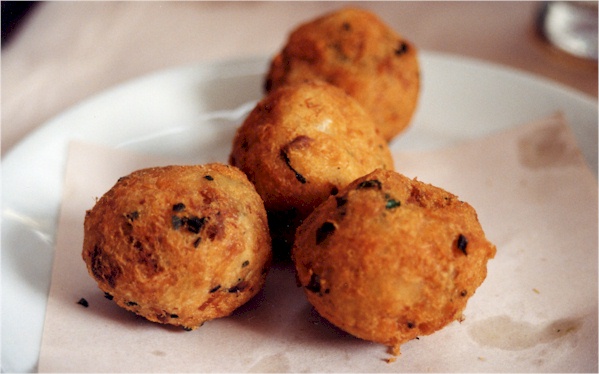
After singing through the history of samba, for a couple of hours, Sérgio and I resumed our bar hopping from a few nights before. He took me to one of their favorite hangouts from the past, a bar called Paulistinha. We ate the best bolinhos de bacalhau I've ever had, danced and singed to some more street samba (this time on a stage closing off the small street from the rest of the commotion in the center), and got generally plastered. Stories of my father's debaucherous years came to the fore, and I even visited the old pool hall where they used to not play any pool at all. Like I said, the bloco gives you a great time, and it seems to guide you towards even more fun...
Over the rest of my time in Rio I went to a few more blocos. One of note was Vaga-Lume, which paraded in the neighborhood of Horto near the Botanical Gardens. Vaga-lume is the name for firefly in portuguese, so participants were supposed to bring a lighter to brighten up the night near the park. Sadly, I missed the organized part of the celebration, but my bus was filled with drunken teenagers singing songs and being generally rowdy. That was a treat; the bus driver almost walked away from his job just to get some peace and quiet. :D But my cousin and my aunt played percussion with the group in this bloco, and I did stick around for the party afterwards. The crowd was the youngest of any bloco, and the sound truck blasted some more electronically infused music while the drummers took a break. Some of the funniest stuff was happening on the side streets, were guys were pissing on every single doorstep and tree, and even girls were straddling between parked cars. But you know, it didn't really smell any different...
I jumped in and out of a few more blocos; whenever I felt like dancing a littgle, there was always one around the corner, ready to make me feel at home.
Or do i give too much credit to my people? I don't know, I was starting to doubt these silly theories of mine, especially because they weren't based on any recent encounters with brasileiros; but now that I felt the warmth of my people, I begin to realize that I was probably right. When we want to, we can make anyone feel welcome, relaxed, at home. And being from there, I really felt that way. Up to that point, I was remembering old adventures from my childhood, reconnecting to places and people I had not seen for more than a decade, and generally having a time-warping experience. It was when I stepped into that bloco, and became part of that crowd, that i began to reconnect these experiences to my self. I snapped out of my state of awe, and became a brasileiro again. Sounds too melodramatic, I know, but if you know me, you know I've thought about this before I put it down here. The bloco is the quintessentially Brazilian experience, even if not all Brazilians take part in it. Well, maybe futebol and corruption have a place in that experience, but they are more placeless than the bloco.
Well, the crowd continued to parade around Lapa, ending at the arches from which it began. The crowd spread out through the square, and the beer runners that had been weaving through the crowd selling cans of Skol placed themselves in the perimeter, now letting the revelers come to them. With this initial dismantling of the crowd, it suddenly began to pour. People were initially in shock, and some didn't even try to run for cover. I was laughing my ass off at the whole situation, but even the bloco could not withstand this toró (torrential downpour). I rushed into a club that happened to be having a live afro-brazilian show, with an Olodum tribute band on hand. Wow! I stayed there perfecting my moves for another 3 hours , until the DJ started playing some shitty hip-hop. Follow the bloco, and you will reach some fun, even afterwards...
 blurry crowd in the bloco in Lapa
Half an hour and four blocks later, we arrived at the beginning of Avenida Rio Branco, one of the main avenues of the center. From there, for a span of about 20 blocks, all I could see was people! Never mind that it had just taken us 30 minutes (and 3 beers) to get through the previous crowd, we were now confronted by more people than I could have imagined, lots of them dressed in black and white polka-dotted garb belonging to the group. I believe there were estimates floating around between 500,000 and 2 million people on the streets, and I think I could believe those numbers (especially over a whole day). We battled our way to the front one beer at a time, and made it very near the sound truck. But I never saw the percussion section. I did see a random tour bus roaming the crowd, with various "personalities" inside, not having nearly the amount of fun those of us in the sun were. :P
 Cordão da Bola Preta, Avenida Rio Branco
Over the rest of my time in Rio I went to a few more blocos. One of note was Vaga-Lume, which paraded in the neighborhood of Horto near the Botanical Gardens. Vaga-lume is the name for firefly in portuguese, so participants were supposed to bring a lighter to brighten up the night near the park. Sadly, I missed the organized part of the celebration, but my bus was filled with drunken teenagers singing songs and being generally rowdy. That was a treat; the bus driver almost walked away from his job just to get some peace and quiet. :D But my cousin and my aunt played percussion with the group in this bloco, and I did stick around for the party afterwards. The crowd was the youngest of any bloco, and the sound truck blasted some more electronically infused music while the drummers took a break. Some of the funniest stuff was happening on the side streets, were guys were pissing on every single doorstep and tree, and even girls were straddling between parked cars. But you know, it didn't really smell any different...
I jumped in and out of a few more blocos; whenever I felt like dancing a littgle, there was always one around the corner, ready to make me feel at home.
Monday, February 18, 2008
Carnaval Brasileiro, 2: photo tease...
Here is a small sample of what you'll soon be able to find on my flickr, and what I'll be talking about for the next who knows how long:


2008.02.26 UPDATE: Pictures up on Flickr!


2008.02.26 UPDATE: Pictures up on Flickr!
Carnaval Brasileiro, 1: airport madness!!!!

First off, my trip was an experience that I needed, and will never forget. There aren't enough words, photos, drawings, or clichés to explain how good this was for me, and what it meant. I reaffirmed part of my identity, reconnected with part of my family, experienced my culture in all its wonder and its misery, saw some incredible places, people, events, and had an extraordinary time!
While I compile my thoughts and images, and try to organize how to best relate this experience, I'll start off with the obligatory complaints and stories about airports, airplanes, and flights; these are most fresh in my mind, I spent a lot of my time in Brasil up in the air, and it wouldn't be my blog with a bit of bitching thrown in...
I'm still waiting for one of my bags to be brought to my apartment. One of them did arrive, but that one was filled mostly with my Carnaval parade costume; funny how things work out. I don't fully comprehend how they could have just one of my bags, but the fact that it was the American side of the deal that screwed things up begins to fall in place with a lot of what I saw and heard in Brasil.
To wit, it was an idiot at the check-in at La Guardia who told me my bags were going directly to my final destination on my first leg of the trip, when I really had to pick them up at customs in São Paulo, then check them back in to Curitiba. Of course, I should have remembered that obvious exercise I had participated in through so many international flights, but in my excitement about going back home I followed the idiot's advice. Surely, there were plenty of incompetent people at the airport in São Paulo, and it was horribly signalized, but there were a few people who helped me with all their will. The woman at the airline luggage department immediately called a dispatcher to pick up my luggage and carry it through customs, and he even apologized for taking too long after coming through. I don't think I could find many people who take that kind of pride in their jobs in airports here. This gratitude for having a job, and willingness to work hard no matter the circumstances are qualities that are definitely a bit lost on me nowadays, but I do take immense pride in the work I do, one way or another. Is this a cultural difference, is it brought on by financial comfort, or what? I guess I have other thoughts and cases where some of these causes come into play, but I felt more comfortable and taken care of in Brazilian than in American airplanes and airports.
The Brazilian airlines always gave a little snack on the plane, no matter how short the flight; they explained exactly what was happening during delays (maybe even too much; I don't need to know which wire on the cooling mechanism of the galley is being fixed...), and were very helpful upon arrival at the airport. Compare that to the silence during delays, the lack of knowledge of airport officials, and the emphasis on security over everything else (including timeliness, comfort, service, and information) of their counterparts in the US, and I begin to confuse which country is so-called first-world. But that gap is narrowing, rest assured, and probably not for the better. I'll touch on that later as well.
And so I still wait, after having to run to catch my connecting flight so I could wait two hours before takeoff and another 45 minutes before landing for no apparent reason... ...only to have my costume but not my clothes... ...I guess I could recreate Carnaval in Washington Heights, but I need a bateria section.
And maybe a bit more warmth, from the weather and the people.
Saturday, January 19, 2008
family cartography
Continuing preparations for my vacation to Brasil:
I've been making a google map of Rio de Janeiro and São Paulo each; trying to find as many places of interest, restaurants, bars, etc., as I can. For Rio, I recruited my parents to help.
Little did I know they would also be including family history and places in their editing! It was great to find out which hospital I was born in, where my mom went to school, etc etc. My dad even included some jokes, historical background, and even poems about certain places!
here's the map for Rio!
I've been making a google map of Rio de Janeiro and São Paulo each; trying to find as many places of interest, restaurants, bars, etc., as I can. For Rio, I recruited my parents to help.
Little did I know they would also be including family history and places in their editing! It was great to find out which hospital I was born in, where my mom went to school, etc etc. My dad even included some jokes, historical background, and even poems about certain places!
here's the map for Rio!
Subscribe to:
Posts (Atom)